|
|
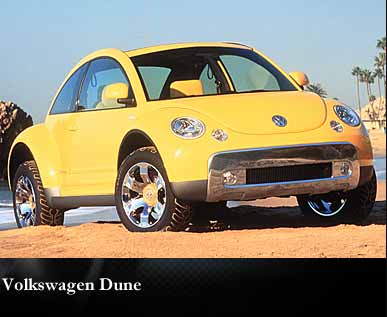
With the crossover fever evident in this season's concept cars, it seems the automakers want all vehicles to be all things to all people. Has the Beetle caught the bug? Well, it doesn't go as far as some concepts, in that it doesn't have a pickup-style cargo bed (and for that we can be grateful). Equipped as it is to go off-roading, however, the Volkswagen Dune definitely crosses a line in the sand drawn by sport utility vehicles.Officially called the New Beetle Dune, this concept appears at first to be all show, but under the chassis lurks the 4MOTION all-wheel-drive system that is just now making its debut in production Passat sedans and wagons. It's powered by a high-torque, 2.3-liter V-5 engine not available in the VW line, and features a six-speed manual transmission. Adjustable-height suspension allows the driver to select a ground clearance to match the terrain, with three positions spanning more than 4.5 inches. In lieu of the standard-issue 16-inch Beetle wheels, the Dune sports 18-inch, six-spoke aluminum wheels with slightly wider higher-profile tires. |
| General Motors? That's right: On Dec. 21, 1999, GM finalized its purchase of the Hummer brand and marketing rights from originator AM General, so this concept sport utility vehicle is officially a GM. It's not just a GM in name, however. The Hummer H2 was developed with AM General's "input, direction and approval," according to GM, but the team that rushed it from zero to complete in 4.5 months for its debut at Detroit's North American International Auto Show Jan. 9 comprised predominantly General Motors personnel.GM's first step was to designate the current iteration of production Hummers "H1," which paved the way for this Hummer H2 "vision vehicle," which examines what the next Hummer could be. (The Hummer has not enjoyed a complete redesign since its conversion in 1992 from the military HUMVEE for civilian sale.) GM has vowed not to monkey too much with a good thing, but has attempted to modernize the world's most capable off-road vehicle. | 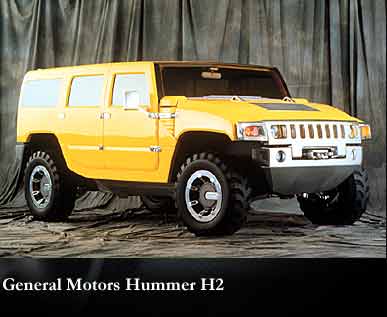 |
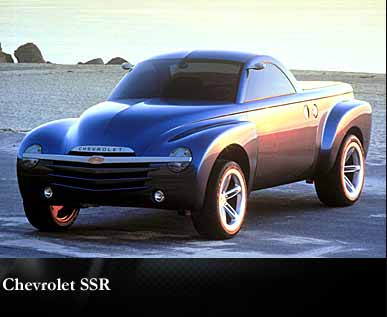 |
What strikes you first about the Chevrolet SSR is the fluidity of its
lines from nose to tail: It almost seems to have been milled from a single
block of steel rather than assembled from multiple klunky components like
most pickup trucks. More than simply a wide-stance pickup truck, the SSR
is an open-air tourer thanks to a retractable hardtop that motors into
a gap between the cab and bed. The top grants the "roadster" part of the
"super sport roadster" description that gives this vehicle its name. The
"super sport" comes courtesy of a 6.0-liter V-8 engine coupled to an automatic,
rear-wheel-drive powertrain.
The retractable hardtop is powered, in the concept-car tradition. A
steering-wheel shifter and bench seat allow the SSR to seat three. The
exterior color is continued in the cabin, a nice touch.
|
| Convertible versions of hardtop vehicles often come with compromises, but here the TT Roadster may set itself apart. The main thing lost in the Roadster is a backseat that is so useless in the Coupe, it might as well not be there either. In the Roadster this space accommodates the folded soft top, of which there are two types: manual, which is standard, and an optional powered version that takes about 15 seconds to lower. A foldable, "semi-hard" tonneau cover snaps into place. The rollbars behind each headrest continue the brushed-aluminum motif of the TT's interior while providing necessary protection in the event of a rollover. Immediately behind the rollbars is a glass window, or "windbreak," that motors up or down on command (a welcome weapon against the wind that curls up over the windshield and blasts the back of a roadster occupant's head). Drivetrain options in the Roadster include the base 180-horsepower engine with either front- or Quattro four-wheel drive, and the new 225-horsepower firebreather, which comes only with Quattro and a six-speed manual transmission |  |
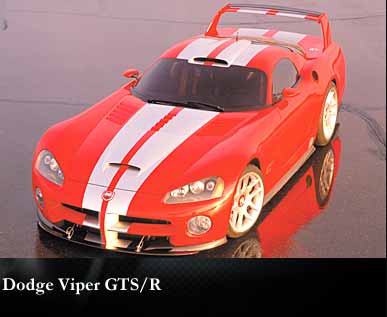 |
The Dodge Viper hasn't been what anyone would call a slouch in its
nine years of production, but since 1996 an even more powerful version,
the GTS-R, has been produced for track racing. The Viper GTS/R Concept
introduced at the 2000 North American International Auto Show in Detroit
is a GTS-R racer made street-legal — and livable, with the accoutrements
of a production vehicle.
The GTS/R has the same powertrain as all Vipers — an 8.0-liter aluminum V-10 and six-speed manual transmission — with the same modifications as the racer, resulting in 50 more horsepower than the standard Viper for a total of 500 horsepower and 500 pounds-feet of torque. The engine is also "dry-sumped," meaning the engine oil is contained in a tank-style reservoir rather than allowed to slosh around in an oil pan below the engine. This ensures that the oil is available to do its duty even under the high centrifugal forces of racing. Zero-to-60 time is estimated at 3.8 seconds, and top speed at 200 mph. The brakes are 14-inch discs with four-piston calipers. The front wheels are 19-inchers with Goodyear P285/30 ZR tires and the rears are 20-inchers shod with super-wide P335/30 ZR tires |
| The Bullitt Mustang concept is named after the 1968 motion picture "Bullitt," in which Steve McQueen, as Detective Frank Bullitt, pursued perps through the streets of San Francisco in a 1967 Mustang GT "fastback." Naturally, this 2000 Mustang GT-based concept's subtle styling modifications are based on that '67. They include a new front fascia and hood, new rear fascia and customized lamps all around. The 18-inch aluminum five-spokes wheels are based on the '67's. Interior changes include racing-style seats and custom gauges. The paint is appropriately called "pursuit green." | 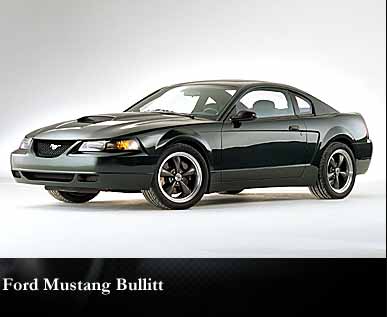 |
.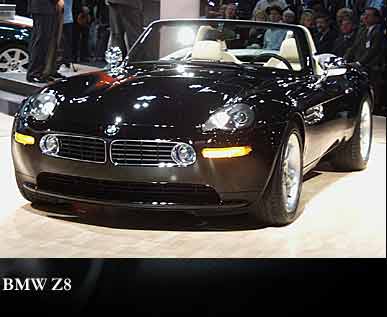 |
In case you didn’t see the BMW Z8 roadster sawed in half in the James
Bond film “The World is Not Enough” (blasphemy!), it makes its North American
debut at the Los Angeles Auto Show. Based on a concept car introduced at
the 1997 Tokyo Motor Show, the production Z8 looks quite a bit like the
original, but without the Batmobile-inspired tonneau hump (for lack of
a more universal description) behind the driver. BMW says the design was
inspired by 1950s race cars, though the Z8 looks at least a little like
many of the other roadsters that have come on the scene as part of a resurgence
inspired by the Mazda Miata.
Where the Z8 parts company with all of them, however, is in power. Equipped with the same fire-breathing 400-horsepower V-8 used in the BMW M5 sedan, the Z8 is claimed to clock 0-to-60 times of under 5 seconds and a top speed that’s electronically limited to 155 mph. Currently the transmission is a Getrag six-speed manual, to which Formula-1-style sequential paddle shifting may be added in the future.Sell'n for about $100.000 |
| The undisputed star of this year's Geneva show is the new 360 Spider, the open-air companion to the beautiful 360 Modena coupe.Styled by Pininfarina, as most Ferraris of recent vintage are, the 360 Spider boasts an all-aluminum chassis with exceptional torsional rigidity, which results in fewer squeaks and rattles. More importantly, it helps the convertible deliver virtually the same handling, acceleration and top speed as the coupe. Ferrari says the power top takes 28 seconds to open or close.Each of the two rollbars behind the seats has a mesh screen to help minimize wind buffeting with the top down. In addition, the reinforced windshield can support the full weight of the car in a rollover. Running gear is identical to that on the coupe — a 400-horsepower 3.6-liter V-8 with a six-speed gearbox. The F1 version has an electrohydraulic actuator with steering-wheel-mounted paddle shifter for quick gear changes. | 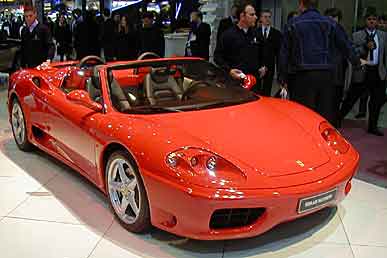 |
. 
|
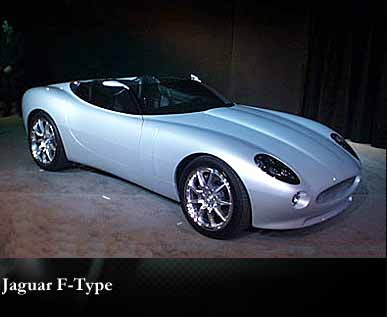
Inspired by the X180 concept car revealed at the Paris auto show in
1998, the F-Type was designed around existing mechanical components, which
led to the car's size and layout. It rides on the same basic platform as
the Jaguar S-Type, Lincoln LS and the upcoming Ford Thunderbird. It is
narrower and shorter than the current XKR.
The new Jaguar is designed to accept a range of powertrain options, starting with the 240-horsepower AJ-V6 engine, introduced in the S-Type sedan. A supercharged version with around 300 horsepower is also possible. Automatic or manual transmissions would drive the rear wheels; all-wheel drive is a production-feasible option |
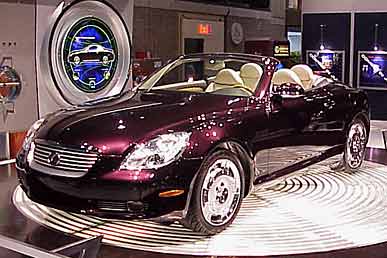
| The SC 430 convertible was shown in a deep burgundy red with a light
beige interior at the New York auto show. It has a fairly aggressive stance
with short overhangs and a short rear deck, but the curves are smoothly
sculpted, befitting the luxury image. Styled both in Europe and Japan,
SC 430’s exterior stylist Sotiris Kovos is said to have found inspiration
in luxury yachts on the French Riviera. Meanwhile in Japan, Satoru Kuno
penned the interior, which features wood and leather rather than “unnatural
forms from plastic.”
A 300-horsepower aluminum double overhead cam engine, the 4.3-liter engine drives the rear wheels of the SC 430 through a five-speed automatic |
.  |